
Despite a wave of acquisitions in recent years, the precast concrete market remains highly fragmented and offers significant consolidation potential. Each year brings new investors into the sector, though most choose to grow through acquisitions or partnerships rather than building new production plants from scratch.
New investors entering the precast market
Even amid a slowdown in the construction sector, Poland’s heavy precast concrete market continues to attract interest from a wide range of industries. It’s one of the few segments of the broader building materials market where multiple noteworthy acquisitions take place every year.
In recent years, increased activity has come from concrete producers (such as Holcim Polska, Thomas Beton, Betard), contractors (including Goldbeck, Depenbrock, Dekpol), and residential developers (like WPBM Mój Dom and Moderna Holding).
Market entry strategy: acquisitions vs. greenfield investments
Acquisitions remain the dominant entry path
Key trend: Nearly all new entrants choose to buy existing production facilities instead of investing in greenfield construction.
Few investments in new facilities
Even long-standing market players have rarely built new factories in recent years.
Notable exceptions include:
- Pekabex Group’s new plant in Gdańsk (2020)
- Rector Polska’s facility in Mszczonów (2021)
- ARP’s factory in Suchedniów (2023)
- Rector Polska’s plant in Jaworzyna Śląska (2025)
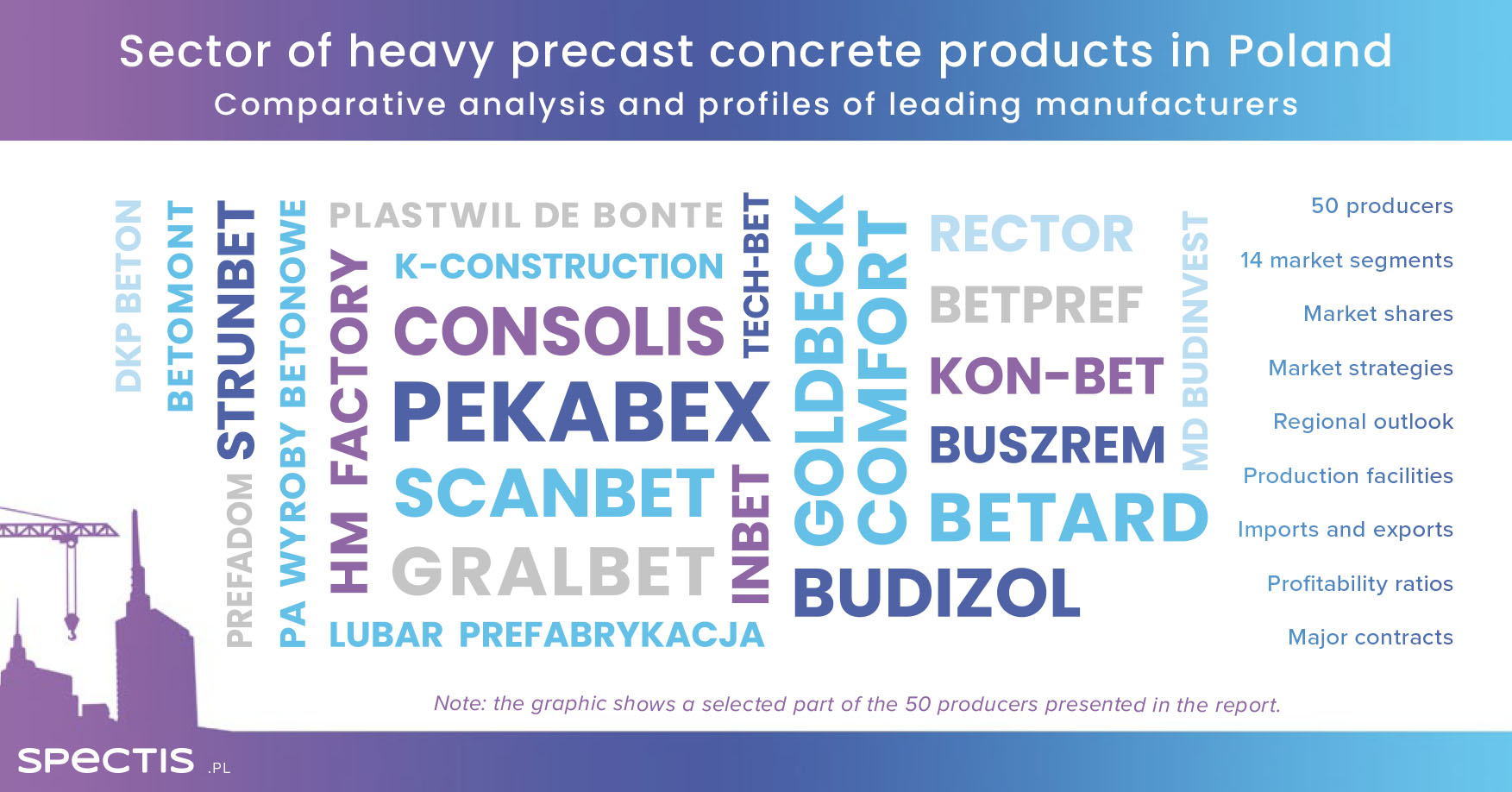
Review of the top 50 manufacturers
Most precast producers in Poland are still relatively small and operate below optimal scale.
Market indicators
- Total revenue (from precast only) of the top 50 producers: approx. PLN 3.7bn
- Average revenue per company: approx. PLN 70m
- Market profile: Dominated by small and mid-sized companies

Revenue breakdown
The top 50 players generate a combined revenue of around PLN 3.7bn from sales of heavy precast elements. That translates to an average of just over PLN 70m per company. Most producers are still relatively small and lack sufficient operating scale. More than half earn less than PLN 40m from precast operations. Around 10 firms report sales in the PLN 50-100m range. Fewer than 10 companies exceed PLN 100m in annual revenue.
The market structure indicates strong consolidation opportunities, particularly in light of:
- Persistent fragmentation of the sector
- The need for economies of scale in precast manufacturing
- Efforts to enter or expand in foreign markets
- Rising technological demands
- Increasing cost optimization pressure
To learn more or download a report sample, visit the store: